Showing posts with label film. Show all posts

26 August 2010

Blue

Whether through the influence of what I have been watching, or my own devices, a sense of malaise has crept in. Happily, I happened to watch Krzysztof Kieslowski's Blue (1993), from his Three Colors trilogy, at the perfectly opportune time.

This the first film of Kieslowski I have seen; I came upon it through a combination of recommendations. First, I saw that Corliss and Schickel put his Dekalog in the All-Time Top 100 Movies; then I read that Ebert said he is "one of the filmmakers I would turn to for consolation if I learned I was dying, or to laugh with on finding I would live after all;" then I read that Kubrik called the Dekalog the only masterpiece made during his lifetime; then I came across the Trois couleurs, which are happily mostly in French and one of which features the enchanting Juliette Binoche.

The plot begins where countless other movies end: death. A woman loses her husband and daughter, and must go on living. This is not another depressing indie, though; this is a film about why we live. Julie is initially destroyed and empty, but we eventually see a bit of who she must have been before the accident.

Motivation is a horrendously complicated subject. Philosophy on the subject leads to religion or nihilism (Aristotle or Nietzsche, as Alasdair MacIntyre put it). There are alternatives, such as economics or whatever Heidegger is doing, but the subject still kills more questions than it answers. Somehow, Kieslowski neatly avoids it all, while showing the underlying dynamic reality. To try and explain it further would be to relapse into philosophy, which would be a disservice to his work. Instead, just see the film. It will make you glad to be alive.

*     *     *

Other things I've been watching lately:

Backyard (2009): A movie about the enormous number of rapes and murders of women in Juarez. Important, but seriously depressing.

The Passion of Joan of Arc (1928): Dreyer's crowning achievement, apparently. I'd seen Vampyr (1932) earlier, and though that was nicer in terms of the narrative (if a little simplistic), but the angles in Joan of Arc are amazing. He's incredibly bold, with a lot of slanted close-ups of her face, shots cutting people off at mid-chest, flipping up-side down shots, and more. The story is predictable, but the camerawork amazing.

Beauty and the Beast (1946): The arms are disturbing, and the acting/casting seemed a little off. The Beast's costume was excellent, though; very wookie before wookies.

The Girl with the Dragon Tattoo (2009): Swedish, excellent. Great acting, good story telling. Not Bergman, but worthy of the country, at least. A little violent and disturbing (more rapes and murders – not sure how this keeps coming up). Another supposedly good Swedish film on my list to watch: Let the Right One In (getting an American remake, apparently).

Prince of Persia: The Sands of Time (2010): Better than I expected; Jake Gyllenhaal was not as miscast as it seemed, and Gemma Arterton was pleasant. Fluff, but decent fluff.

Salt (2010): I hate Angelina for her PR, and don't think she's that good of an actress, but she can carry an action flick. Apt timing, too, with recent revelations about Russian spies who have been living in the US for years. A bit generic, and the sequel setup was obnoxious, but otherwise decent.

Camille (1936): Greta Garbo. There has never been a more humanizing film about gold digging made.

Murder on the Orient Express (1974): Agatha Christie, but dark, very dark. The opposite of another Lumet classic, 12 Angry Men (1957). A unique murder mystery in classic style.

19 August 2010

Reflections

Some thoughts on what I've seen lately:

Frankenstein and Bride of Frankenstein: A bit sentimental, but surprisingly relevant as the first artificial species are created by Venter et al. Boris Karloff is good, and the Bride is superlative for the hair alone, plus the Metropolis machine-woman style of movement. I'd like to see The Spirit of the Beehive, a Spanish film about a girl's reaction to this film. I also need to see Bella Lugosi's Dracula at some point, which immediately preceded this in Laemmle's production studio.

I vitelloni: I've seen quite a lot of Fellini, but never saw this, as it's considered one of his more minor works. However, I was very pleasantly surprised; it is more accessible than most Fellini, but still an exceedingly strong piece of work. The premise is the universal coming-of-age story, but Fellini does it in a fresh and engaging manner, offering a character study of a group of five friends from a small town in Italy, each representing a different archetype, or part of the self, depending on your viewing. It's really the perfect antidote to the overindulgence of buddy comedies by Apatow and company, with moments to make you smile and cringe, and often make you think uncomfortably about your own life.

The real triumph of the film is the depth of the character study through use of universal themes. Each of the five vitelloni is a deeply dynamic character, struggling with his life in a unique manner. Most magical among these characterizations is Moraldo, the youngest of the gang, who quietly observes the shenanigans of the rest. Still, at the end of the film, despite his small amount of screen time and lines, he is clearly the most interesting of the characters, one we want to follow beyond the film. As he serves as Fellini's alter ego, we can happily do so through his other films.

The Bicycle Theif: De Sica's portrait of a man in postwar Italy who needs his bike to keep a job. It gets stolen. His life is sad. I really don't think this is a great movie, despite its reputation. It captures the nature of poverty well, the kid is cute, and the father tragic, but it is missing depth beyond the social commentary.

Z: Costa-Gravas, a classic thriller, and a good piece of political cinema. Really well put together; it will keep you involved despite getting caught up in politics. The assertion that "I'm not a political person" becomes chilling after this. And yes, I watched this because of the Chuck reference.

The Cabinet of Doctor Caligari: A nice silent horror-fairy tale. Not really exceptional, except that I am obsessed with the set design. With all of the off-kilter windows and plays on perspective, combined with the soft-painted effect, it is the perfect fairy-tale set, and the inspiration to many ever since. One of those movies you want to frame and put up on your wall.


The Virgin Spring: Like I vitelloni, one of a handful of Bergmans I missed. Without spoiling too much, it is classic Bergman, but not as exceptional as some of his work. Partly, I prefer his non-historical work, though this packs a punch. I believe this was the source for The Last House on the Left, although that looked terrible. This was not. If you want more on the plot look it up. I just feel I shouldn't spoil too much; it's better to go in ignorant, but be aware that it gets violent.

Y tu mamá también: Curious...I really don't know what to say about this movie. It's strong. A different sort of road trip movie, I guess.

Dune: David Lynch, not the 2000 one. I think I once saw part of the 2000 one, because I remember the eyes, but I fell asleep. Lynch's film was not wholly Lynchian in the sense of Mulholland Dr. The film pulls very strongly from Star Wars, and I'm honestly a bit surprised it has a cult following, as the effects are second-hand, and the story is not long enough (without Herbert's book) to really create a mythology. Not a bad film, really, just middling. Sorry Chuck. Tron was better. Looking forward to the new one, too.

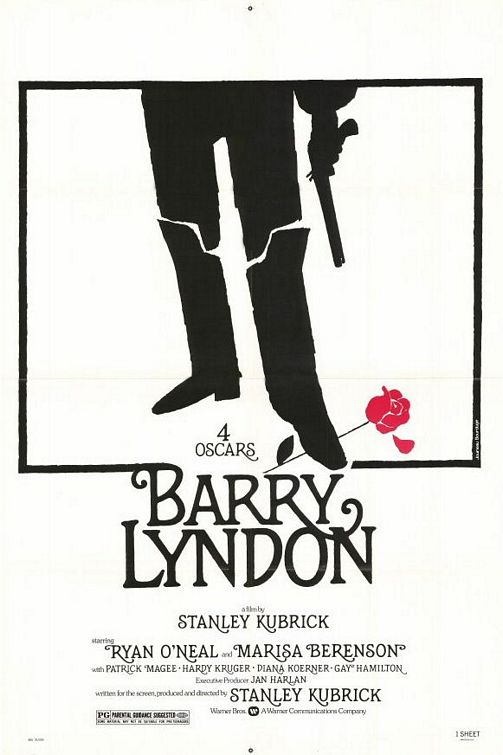
I love this poster.
Barry Lyndon: One of Kubrik's masterpieces I'd missed out on. As a European period piece character study, the film really is a masterpiece; we follow Barry through a curious life and a series of other characters, in the end leaving them all behind. We really do understand him, even as we do not fully care for him much. In the end, signing a check has never been so sad.

Somehow, I feel this film deserves to be contrasted with Altman's Gosford Park and Renoir's Rules of the Game from which Altman worked. Kubrik does an extraordinary job of following one man, whereas Altman and Renoir present their distinctive event-stories without a clear protagonist. Personally, I prefer Kubrik's vision as it engages the audience more, even if I appreciate the value of Altman and Renoir's styles. They may be more innovative (in this instance), but Barry Lyndon has the feel of a great Greek or Shakespearean tragedy, which is hard to forget.

The Battleship Potemkin: My first Eisenstein. I know the film is monumental in the history of cinema for its use of montage and the Odessa steps sequence, but from a modern perspective, the propaganda is just odious, and in the way of good storytelling. I feel that if he has forgone a bit of his political message, he could have made a much more engaging drama, but perhaps then it would not have been quite so monumental.
Somehow, it doesn't tip over.

Tokyo Story: I love this film. As my first Ozu, this was my introduction into his brilliance in capturing the little moments in life, the nuances of relationships. I've honestly never felt that a movie has captured family relationships so well. He accomplishes this through capturing the moments that are not in a book or script, like packing a bag, or figuring out where visitors will sleep. At the same time, his scenes end right before they would start to get boring, almost jarringly. Particularly poignant for anyone with parents or grandparents, i.e. everyone, it is impossible not to think of that old grandma, or the way your dad remembers the things your mom forgets, and so on. Just a lovely film. I challenge anyone to not love the old couple.
"Love us! We're cute and doddery!"

A note: The film owes as much to fantastic acting as Ozu himself. Dancing slowly can be much harder than dancing quickly.

If you only watch one of these, watch this. Personally, I'm very excited to get into Ozu's other films.

25 July 2010

Propaganda Films

Through whatever coincidence, I happened to watch Chaplin's The Great Dictator, Frankenheimer's The Manchurian Candidate, and Lubitsch's Ninotchka with Greta Garbo in sequence, shortly after seeing Hitchcock's Notorious. To call these movies "propaganda films" is an exaggeration to an extent, but they do all contain strong political messages, and came out in a time where they served to influence public opinion, qualifying them for the term.

Chaplin and Hitchcock are concerned with Nazis; Chaplin at the beginning the war (1939) and Hitchcock at the end (1946). Chaplin's is perhaps the most straightforward propaganda of the lot, with characters often sermonizing directly to the camera. Notorious, on the other hand, is literally playing off of hatred of the Nazis, but is functionally concerned with the likelihood of the Soviets getting the bomb, switching names presumably for diplomatic purposes. Ninotchka offers an early comic view of the Soviets comparable to Chaplin's Nazis, though with a different style, but again with fairly overt propaganda. The message (one should be a capitalist because we're richer, even if they are more virtuous and rational) is slightly confused, though a fascinating look at capitalist attitudes towards the USSR pre-McCarthy.

Richard Condon's book The Manchurian Candidate, on the other hand, came out in 1959, followed by the film in 1962, in the wake of McCarthyism, and the influence is clear, though deliciously twisted: the protagonist's string-pulling mother makes a name for her Senator husband by falsely accusing others of being Communists, while in fact, she is a Soviet agent. The film serves its purpose as propaganda of presenting the Communists as evil caricatures, but simultaneously condemns the McCarthyism of the right. The result is a surprisingly centrist movie, though centrist in the sense that the center is right, not that everyone is right.

* * *
Comparing these films with a monument of propaganda film such as Leni Riefenstahl's Triumph of the Will makes their political role more clear. While Triumph is a documentary – about the 1934 Nazi rally in Nuremberg – but even so, the film's political message is oddly translucent, even though the Nazi rallies it filmed were anything but subtle. Instead, Riefenstahl presents the rallies as she sees them: as a momentous occurrence in German politics, shot in style through her talented lens. What makes Triumph a propaganda film is not its intentions, but its substance.

The four other movies, then, are more properly propaganda films than Triumph of the Will in that their creators also created the messages contained in them. If they are thus propaganda films, why, then do they hold such a different position in the history of film than Triumph, which is widely viewed as technically brilliant but morally reprehensible? Their content is less offensive to Americans, though their targets would find it quite as disagreeable as non-Fascists find Triumph. Indeed, this is really their only redemption: that we agree with them.

The obvious question, then, are what are our current propaganda films? First inclination is to look at war films, because this has long been the purpose of propaganda: to garner support for a war. However, in the wake of Coppola's Apocalypse Now and other Vietnam movies, war movies have largely transformed into protest movies, which are only propaganda if taken to be against their own country. They are not for an opposition, but rather for a reformed country. Today, this takes the form of movies like The Green Zone, which condemns the W administrations manufacturing of WMD evidence and general approach in Iraq. A more curious recent case is The Hurt Locker, which is not largely a protest film, but rather a study of war and a group of characters in it, in almost a documentary-like atmosphere. It is not a propaganda film, but something quite different.

So where are the propaganda films? They are now a division of politically critical film that presents one side as particularly justified, and demonizes the other. The most obvious one in recent history is Avatar, which makes no effort to hide its political agenda in anticipation of the fact that most people will agree with it. It is not the first, though; the pre-Nolan Batman films come to mind, presenting the crime waves sweeping America as something purely evil rather than an undesirable effect of poor governing.

No, propaganda films are not gone, nor will they be in the future. The good news is that they are still fascinating studies. The other – let's not quite call it bad – news is that they still shape how the public thinks. In some ways, this is good: because Hollywood must create films to appeal to a wide audience, it helps unify the American people in the center; their more critical peers help people think critically about their own beliefs; and they can be a force for the justice of the moment, moving the world forward. Gay issues, green issues, wars, vegetarianism and more are all within the moral purview of Hollywood, making the entertainment industry a moral authority at least as great as governments or religions. And because their only demand is that they must satisfy the peoples they serve – and therefore make money – without the limitations of the bureaucracy of governments, or the inflexible traditions of religions, I honestly think that Hollywood is a fairly good moral arbiter.

a lot of films

so unfortunately, this blog has become semi-defunct, though I am constantly running across bits or ideas that I think that I should stick up here. Anyway, given my current interests, I think it is going to shift a bit to a bit more traditional form of my reflections on whatever media is impressing me at the moment, rather than a stream of ideas and excerpts, though I hope to add those, occasionally, too. In any case, I will try to be more regular, at least for the sake of my own writing ability and clarity of mind, if not my phantom-readers (who knows, maybe you exist). I always do find reading small blogs of people I know to be a titillating view into their minds.

I have been watching an enormous amount of film lately, partly due to my own interest in it, partly due to the convenience of NetFlix, and partly because it offers a much needed reprieve from job-hunting. A partial list of what I have watched lately, from most to least recent, jumbled a bit:
  • Ninotchka
  • The Great Dictator
  • Aliens
  • The Manchurian Candidate (1962)
  • Che, Part 1
  • Carne Tremula
  • The Losers
  • Notorious
  • The Purple Rose of Cairo
  • Day For Night
  • Munich
  • Habla con Ella
  • 12 Monkeys
  • Toy Story 3
  • She's Out of My League
  • The A-Team
  • Stomp the Yard
  • The Pianist
  • Eros
  • My Blueberry Nights
  • Brazil
  • 2046
  • The Green Zone
  • Ondine
  • A Touch of Zen
  • Solaris (1972)
  • The Rules of the Game
  • Gosford Park
  • A Single Man
  • The Seven Year Itch
  • Hot Tub Time Machine
  • Nashville
  • As Tears Go By
  • New Moon
  • Twilight
  • Kick-Ass
  • Ashes of Time Redux
  • Factory Girl
  • Black Orpheus
  • Rebecca
  • The Bounty Hunter
  • Chungking Express
  • Baby Face
  • Iron Man 2
  • In The Mood for Love
  • Fitzcarraldo
  • The Seventh Seal
  • Aguirre, the Wrath of God
  • Throne of Blood
  • Yojimbo
  • Rashomon
  • Ran
  • Sawdust and Tinsel
  • Fanny and Alexander
  • Smiles of a Summer Night
  • Ikiru
  • Crazy Heart
  • Invictus
  • Cries and Whispers
  • Winter Light
  • Amores Perros
  • Modern Times
  • The Silence
  • Precious
  • Volver
  • Through a Glass Darkly
  • Blow-Up
  • Taxi Driver
  • Julie & Julia
  • Nine
  • The Imaginarium of Doctor Parnassus
  • The Princess and the Frog
  • The Fantastic Mr. Fox
  • A Fistful of Dollars
  • A Serious Man
  • An Education
  • Alien
  • Up in the Air
  • La Notte
  • L'Avventura
  • Reservoir Dogs
  • Inglorious Basterds
  • The Blind Side
  • The Hurt Locker
  • The Elephant Man
  • City Lights
  • Avatar
  • Coraline
  • Sherlock Holmes
  • Nosferatu the Vampyre (1979)
  • Nosferatu, A Symphony of Horrors (1922)
  • Juliet of the Spirits
  • Vampyr
  • The Informant!
  • Amarcord
  • Double Indemnity
  • The Shining
  • Sunrise: A Song of Two Humans
  • Wild Strawberries
  • The Diving Bell and the Butterfly
  • Rififi
  • Satyricon
  • Nights of Cabiria
Mm, so that list ended up being a bit longer than I anticipated, and reaches back months and months now, omitting a lot of important – and more unimportant – ones I have forgotten. This is all part of a larger project to extend my experience of films beyond the five or so years I have really been watching, and to ground my film knowledge in the classics, new and old, while keeping abreast of what's happening now. Frankly, it's a large and unending task.

Things that have stuck out: my love for Fellini, Bergman, and Wong Kar-Wai, despite the fact that each only has one movie that I truly love without reserve; a patience with commercialized trash (yes, I love both The A-Team and The Silence); a vague dislike for French New Wave and Antonioni; a feeling that Soderbergh bests Scorsese for best living American director, despite general opinion; that Wong Kar-Wai is without doubt at the top of international cinema at the moment; and that I have a lot left to watch.

I have been working from the IMDb Top 250 (I've now made it through 97 of the top 100; still missing Inception, Once Upon a Time in America, and The Green Mile), the All-TIME Top 100 Movies list by Corliss and Schickel, the Oscar nominees for the major awards, and my own inclinations.

Anyway, the purpose of this re-opening post is to set the stage a bit for what is hopefully to follow: meditations on the media occupying me at the moment. If you're still reading, what are you consuming at the moment? Let me know!

10 February 2008

Juno

Well, I failed on all of my promises, and writing for the last week. Briefly: eating aforementioned food (Pierre Hermé stuff: incredible; Verlet coffee: good, but not as good as Café Richard's Sumatran; Poilâne: underwhelming, probably because I prefer white bread; Quatrehomme cheese: good), going to the Louvre (huge, a lot of boring political art, though it's all very meticulously created), some other things, watching a lot of TV and movies, cooking a little (pepe, tiny ball-like pasta, with soft goat cheese and pepper being the best, but also mexican rice because there's no good mexican here), going to church (odd; there's some weird dynamics with language and religion, perhaps to be explored later).

Lately of note, though, is my viewing of Juno. If you don't know anything about it, go here to watch the trailer and familiarize yourself with it if you plan to continue reading. Obviously it has been getting fantastic reviews, and it has a lot of actors and actresses I am fond of, so I really wanted to see it, but somehow didn't until yesterday.

Acting
I feel that Jennifer Garner has a lot of talent which as of yet has not fully been put to use, partially due to being stuck in with the Afflecks and Kevin Smith and that lot (though perhaps Casey will prove me wrong and Gone Baby Gone was not terrible). If Alias had skipped all the Rambaldi crap and been a bit less formulaic in its writing, she would've gone a lot farther. Plus, she seems a lot smarter than the average actress. She is perfectly cast in Juno with her noted introverted, perfectionist personality with a noted passion for family as a perfectionist upper middle class suburban mom, but missing the kids. You spend the movie scared that she'll be too strict with her adopted kid, but knowing that she really cares and ultimately won't screw up, even if her kids will hate her as teenagers unless she relaxes significantly.

I loved Arrested Development for its comedy even despite perhaps being politically colored in its location on Fox, who longs to show us that Republicans can be funny, even if they are corrupt. Jason Bateman did a fantastic job there as a voice of reason, and a fantastic job here in a completely different role as a suburban husband stuck in his 20's. It's good to see he's got some range, even if his emotional depth is more average.

Obviously Arrested Development was also the source of Michael Cera, who has recently enjoyed a jump to stardom with the rise of awkward comedy, particularly in Superbad. It is really nice to see that in Juno he does not get presented as a loser, even if he is.

J.K. Simmons gives what I would say is his best performance to date, as Juno's caring blue collar father. While obviously a stock character, I found him one of my favorite actors in the otherwise pretty unbearable Spiderman series.

Awkward Comedy
Napoleon Dynamite started the recent movement towards awkward comedy in a very love it/hate it indy film that made it big. Since then, it has progressed somewhat to a slightly more realistic, more friendly sort of style. The Office brought it to television; Little Miss Sunshine brought it to the family; Judd Apatow injected it with his own fraternalism theme in his small awkward empire crowned with Knocked Up. I would like to argue, however, that awkwardness has thus far been best utilized in Juno, which not only uses its awkwardness for comedy (a bit of an acquired taste, admittedly), but also to make a social commentary on why it's awkward, as worlds collide (Juno's slightly smart but loserish teenagerness, her school, her parents lower to middle middle classness, her classmate outside the clinic, the clinic, Vanessa's suburban perfection, Mark's elongated 20's). The problem is that while this is effective, the awkwardness is overwhelming to the point of painfulness.

Direction: Broad-Stroked Realism
Jason Reitman did a fantastic job of using very broad strokes while maintaining very deep color in his direction. It's a bit like a very sweeping waltz, with arc after arc, never showing too much, but still creating deep, dynamic characters. He leaves us in serious doubt about Juno's plans by not showing us her note to Vanessa until the very end, framed on the wall, in very Juno-esque language, on the back of an oil change receipt, on the wall of an immaculate baby's room. Coupled with shots like that of Juno reaching into the backseat of her minivan, looking for something to write on in such a manner as to leave us slightly worried for the baby, Reitman manages to fully engage the audience in the plot while keeping a strong sense of reality.

The oddity of it is that after the film, I was still left feeling slightly unconnected with Juno. I am convinced that this is only in relation with other films, and this is not actually a weakness, but a stylistic point. I have no desire to be Juno, though I do not dislike her, but I did remain very connected to the story as a whole. This is a little different perspective than usual, as I do not attach myself to the protagonist, but do remain attached to her choices which make up the story. Reitman used awkwardness to make this possible, but I think it could be done with other styles, if well enough made. The director must avoid, however, creating a protagonist that the audience does not like (a particular risk of awkward comedy which for me killed the first season of The Office and 40 Year Old Virgin, along with a number of otherwise crappy films/series/books/etc.). This masterful manipulation while maintaining a kind of Rodin-like unfinished surface with striking realism is what makes this film great, despite being so awkward I literally needed a break in the middle.